
cash-flow
Enterprise B2B accounts receivable, 4-pass Nordic & EU remittance reconciliation, conditional survival payment forecasting, and 13-week liquidity stress-testing platform for mid-market treasury teams and accounting advisories.

Om den här modellen
Description
Product Overview
cash-flow is an enterprise accounts receivable, remittance reconciliation, payment-timing intelligence, and 13-week liquidity stress-testing platform built for European and Nordic B2B organizations, multi-entity treasury teams, and outsourced accounting advisories. Operating within the financial operations and treasury management category, the platform addresses one of commercial finance's most persistent bottlenecks: converting fragmented ERP invoices, multi-format bank statements, and unstructured customer remittance advice into verified cash allocations and reliable short-term solvency visibility.
Across European B2B commerce, finance controllers and advisory accountants spend hours each week reconciling lump-sum bank transfers, resolving early-payment discount deductions, validating payee identities, and manually checking statutory collection rules before sending payment reminders. Traditional spreadsheets and basic bookkeeping add-ons frequently commingle legally restricted tax holdings with operating liquidity, overestimate near-term cash inflows, and leave organizations exposed to regulatory or payment-routing errors.
cash-flow transforms this reactive workflow into an exception-first treasury command center. By combining deterministic financial clearing rules, multi-signal AI document understanding, conditional payment-horizon forecasting, and automated statutory compliance guardrails, the platform enables finance teams to reconcile complex settlements rapidly, isolate restricted tax funds from true operating cash, stress-test 13-week liquidity corridors against customer payment delays, and execute compliant collection workflows with full auditability.
The Problem
European and Nordic B2B finance teams operate in an environment where extended payment terms, overdue receivables, and complex clearing standards create daily operational friction and working-capital uncertainty. According to European payment benchmark data, 52% of businesses report negative operational impact from late commercial payments, while average B2B settlement cycles stretch to 63 days when combining agreed credit terms with post-maturity delays.
Despite the financial stakes, day-to-day receivables and cash-flow management remain heavily manual and fragmented across disconnected systems:
- Labor-Intensive Remittance Matching: Finance specialists spend nearly 10 hours per week cross-referencing incoming bank transfers against open invoices. When customers pay multiple invoices in a single lump sum, deduct early-payment cash discounts, omit structured payment references, or send remittance tables via PDF and email attachments, standard ERP matching rules fail and force manual line-by-line investigation.
- Distorted Cash-Flow Visibility: Conventional cash-flow dashboards often aggregate all bank balances into a single figure—dangerously blending legally ring-fenced employee tax withholding accounts with spendable operating cash—or assume that overdue invoices will still settle on their original due dates.
- Regulatory and Statutory Collection Risk: Sending premature collection fees or inaccurate dunning notices across Nordic and European jurisdictions exposes creditors to statutory invalidation and customer disputes. Controllers must manually track mandatory post-maturity waiting periods, commercial dispute holds, and jurisdiction-specific late-payment interest and compensation caps across Norway, Sweden, Denmark, Finland, Germany, the Netherlands, and the United Kingdom.
- Payee Verification and E-Invoicing Friction: Evolving European Instant Payments Verification of Payee (VoP) rules and Peppol BIS 3.0 / EN 16931 e-invoicing standards require strict alignment between trade names, legal registry identifiers, IBANs, and structured discount or penalty terms before transactions clear.
- Multi-Entity Portfolio Blind Spots: Outsourced accounting firms and group controllers managing dozens of legal entities lack a unified view to detect which entity faces an upcoming liquidity buffer breach, an unallocated cash backlog, or a stale bank feed.
How the Product Solves the Problem
cash-flow replaces manual spreadsheet triage with a structured, end-to-end operational pipeline that connects financial data ingestion, automated clearing, predictive liquidity analytics, and guarded human execution.
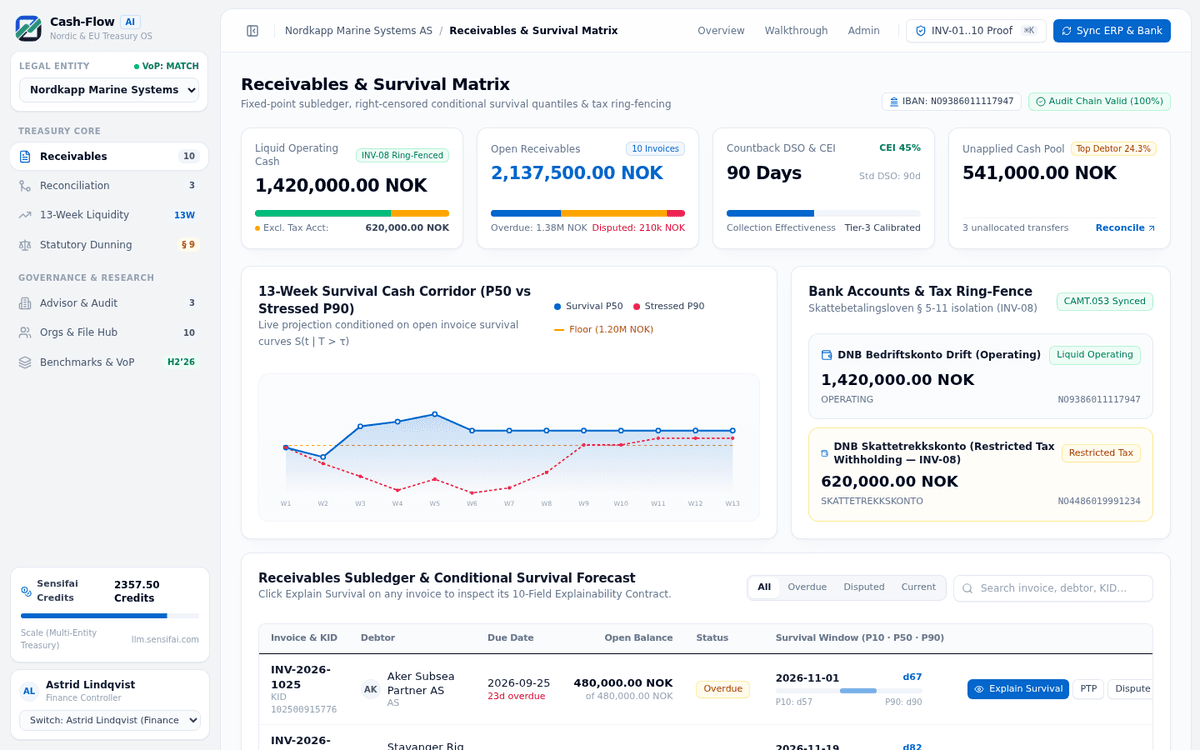
When ERP subledgers, bank statements, Nordic clearing files, or e-invoices enter the platform, cash-flow normalizes every record into an immutable, audit-grade financial ledger and immediately separates restricted tax withholding balances from liquid operating cash. Incoming payments pass through a multi-stage reconciliation workflow: structured Nordic clearing references, early-payment discount terms, and multi-invoice lump sums are matched automatically, while unstructured remittance documents are analyzed by evidence-grounded AI to generate line-item allocation proposals for one-click controller approval.
Simultaneously, the platform evaluates every open receivable using sector- and size-calibrated survival forecasting to project realistic optimistic, expected, and conservative settlement dates based on the invoice's current age. Finance leaders can interact directly with a 13-week cash-flow corridor—simulating customer payment delays or dispute holdbacks in real time—while built-in statutory compliance gates verify waiting periods, dispute statuses, and bank account identifiers before any outbound reminder or collection notice is dispatched.
Problem-Solving Flow
Value Creation Model
cash-flow creates commercial value by compressing the order-to-cash reconciliation cycle, improving the reliability of short-term treasury forecasting, reducing regulatory compliance exposure, and increasing the number of legal entities a finance team or advisory practice can manage without additional headcount.
Value Creation Table
Key Benefits
cash-flow delivers measurable operational improvements across day-to-day accounts receivable clearing, short-term cash forecasting, and statutory credit control.
Benefits Table
Before vs. After
Deploying cash-flow shifts financial operations from fragmented, spreadsheet-driven administration to unified, exception-first treasury execution.
Transformation Table
Customer Journey
cash-flow integrates into the daily and weekly financial rhythm of corporate treasury teams and accounting advisories through a structured eight-step operational lifecycle.
- Entity & Integration Onboarding: Organizations configure legal entities, connect ERP subledgers and bank accounts, invite team members via role-scoped invitation codes, or upload multi-format financial files (CSV, XLSX, PDF, ISO 20022 XML, Peppol UBL, MT940, Nets OCR, BgMax).
- Subledger Normalization & Tax Isolation: The platform validates incoming records, enforces payee name verification, and isolates restricted tax accounts from liquid operating cash.
- Multi-Pass Remittance Reconciliation: Incoming bank settlements are evaluated through deterministic reference, discount, and combinatorial matching passes, while complex remittance texts are parsed by AI into structured allocation candidates.
- Controller Review & Subledger Commit: Finance operators review proposed allocations, approve matches with a single click, and update canonical invoice balances with full audit traceability.
- Survival Forecasting & Benchmark Calibration: Open receivables are scored using sector- and size-calibrated conditional survival models to produce P10, P50, and P90 payment dates and explainability drivers.
- 13-Week Liquidity Stress Simulation: Treasury leaders adjust debtor-delay and dispute-hold parameters to inspect weekly cash corridors against minimum buffer thresholds and generate executive risk briefings.
- Statutory Compliance & Dunning Dispatch: Overdue invoices are screened against waiting-period rules, dispute locks, and jurisdiction-specific interest/fee schedules before dispatching token-locked notices.
- Audit Verification & Portfolio Governance: Every state transition, write-off approval, and settlement allocation is sealed into a hash-chained audit ledger for ongoing governance.
Operational Flow
Who Benefits
cash-flow is designed for collaborative adoption across corporate finance departments, executive leadership, and external advisory practices.
Customer Value Table
Business Impact
By unifying receivables clearing, survival-based liquidity forecasting, and statutory compliance into one platform, cash-flow supports tangible improvements across financial and operational performance areas.
Business Impact Table
Strategic Value
Beyond solving immediate accounts receivable bottlenecks, cash-flow helps organizations modernize their financial operating model:
- Consolidation of Fragmented Treasury Workflows: Unifies remittance clearing, credit collection compliance, e-invoice validation, and 13-week liquidity forecasting—eliminating the need to stitch together separate dunning plugins, spreadsheet cash trackers, and manual banking scripts.
- Standardization Across Multi-Entity Groups: Establishes consistent credit control rules, statutory interest calculations, and liquidity stress-testing standards across subsidiaries operating in NOK, SEK, DKK, EUR, GBP, and USD.
- Institutional Knowledge Retention: Captures debtor payment behavior, dispute histories, promise-to-pay adherence, and reconciliation logic inside a structured system rather than individual spreadsheets.
- Audit-Ready AI Adoption: Demonstrates how enterprise finance teams can adopt generative AI for unstructured document parsing and executive reporting while preserving strict accounting conservation laws and human-in-the-loop governance.
- Readiness for Evolving European Standards: Prepares finance operations for European Instant Payments Verification of Payee (VoP) mandates, Peppol BIS 3.0 / EN 16931 structured settlement terms, and EU AI Act transparency requirements.
Differentiation
cash-flow stands apart from generic accounting add-ons and legacy enterprise treasury suites through six documented capabilities:
- Hybrid 4-Pass Deterministic & AI Remittance Engine: Combines exact Nordic KID/OCR Modulo-10/11 and Bankgirot clearing validation, early-payment discount (kassarabatt / Skonto) verification, and combinatorial subset-sum matching with human-gated AI extraction for unstructured remittance advice.
- Right-Censored Conditional Survival Forecasting: Replaces static due-date rollups and naive regression with sector- and decile-calibrated conditional survival quantiles (P10, P50, P90) and a 10-field explainability contract on every open invoice.
- Native Nordic & European Statutory Compliance Engine: Embeds statutory late-payment interest rates, fixed compensation rules, bracketed collection fee schedules, and mandatory waiting-period gates across Norway, Sweden, Denmark, Finland, Germany, the Netherlands, and the United Kingdom.
- Strict Restricted Tax Cash Ring-Fencing: Automatically segregates Norwegian Skattetrekkskonto tax withholding balances from liquid operating cash so 13-week liquidity corridors never treat restricted tax funds as spendable working capital.
- Pre-Settlement Verification of Payee (VoP) & Peppol Validation: Includes calibrated corporate name normalization and fuzzy matching aligned with European VoP rulebooks alongside Peppol BIS 3.0 and EN 16931 e-invoice validation.
- Epistemic AI Quarantine & Token-Locked Communications: Guarantees that AI models never directly mutate subledger balances or alter verified creditor IBANs and statutory amounts in outbound customer communications.
Why It Matters
In B2B commerce, an organization's solvency depends not on the revenue recorded on issued invoices, but on the timing, certainty, and compliance of actual cash conversion. When finance teams rely on manual remittance spreadsheets, blended bank balance snapshots, and ad-hoc collection emails, working capital remains trapped in unapplied receipts and preventable payment delays.
cash-flow connects technical rigor—deterministic clearing, calibrated survival analytics, statutory compliance state machines, and guarded AI assistance—directly to commercial outcomes: faster cash application, transparent 13-week liquidity foresight, lower regulatory risk, and scalable multi-entity treasury governance. For mid-market enterprises and accounting advisories across the Nordics and Europe, it provides the operational clarity required to protect cash flow and lead with financial confidence.
Nyckelfunktioner
Användningsfall
- B2B finance controllers reconciling multi-invoice lump-sum transfers, early-payment discounts, and unstructured PDF remittance advice
- CFOs and treasury directors stress-testing 13-week operating cash corridors against customer payment delays while isolating restricted tax holdings
- Credit control teams enforcing statutory waiting periods, late-payment interest, and verified IBAN locks across Nordic and European jurisdictions
- Outsourced accounting firms and fractional CFOs monitoring solvency risks, unapplied cash, and VoP alerts across multi-entity client portfolios
Prisplaner
Prisplaner
Relaterade produkter


tiretread-check
tiretread-check — AI-Powered Workspace on Sensifai


SnoreLab
Clinical-grade nocturnal acoustic intelligence for snoring vibration classification, decibel mapping, and obstructive sleep apnea screening.


SleepLullaby Maker
AI-powered personalized infant sleep lullabies with baby's name, 60 BPM entrainment, and pediatric calming soundscapes.