
Greenhouse AI — Autonomous Glasshouse Intelligence
Autonomous overlay for commercial Venlo glasshouses: closed-loop climate and energy MPC, sticky-trap pest computer vision, 1–8 week harvest forecasting, and root-zone irrigation dry-back control.
Om den här modellen
Description
1. Product Overview
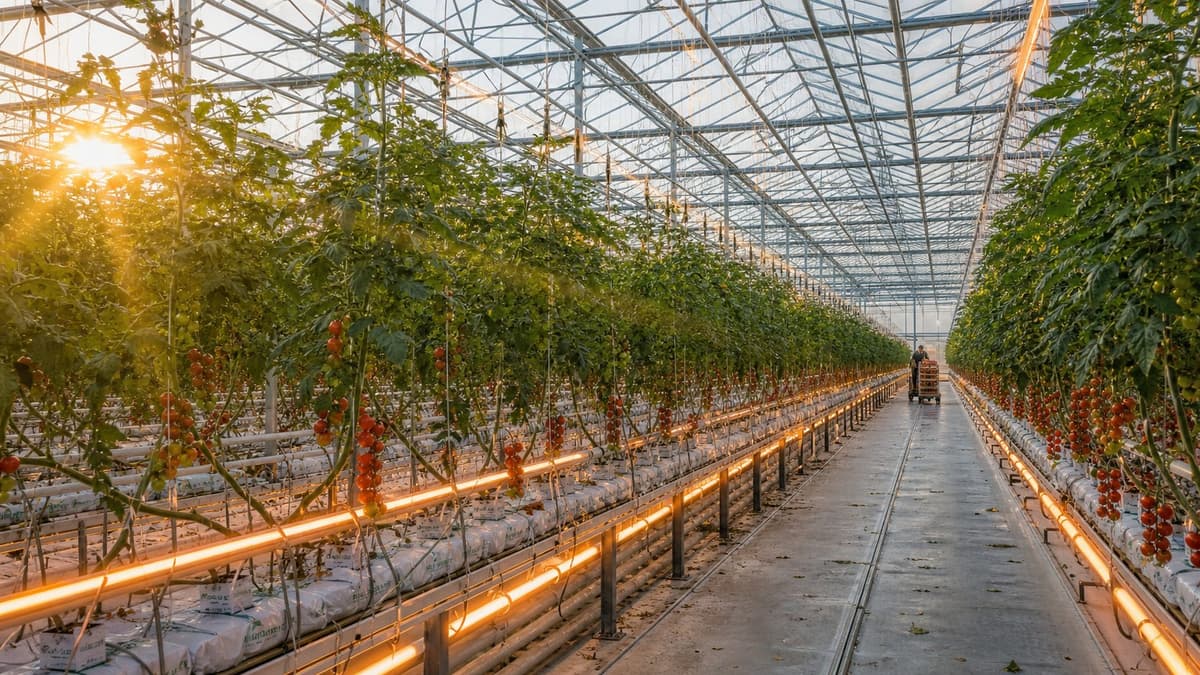
Greenhouse AI is an enterprise-grade autonomous operational overlay engineered for commercial high-tech Venlo glasshouses cultivating high-wire vine crops, including indeterminate tomatoes, sweet bell peppers, and English cucumbers. Designed to integrate directly with established environmental control computers—including Priva, Hoogendoorn, and Ridder—Greenhouse AI elevates commercial protected horticulture from reactive manual supervision to continuous, data-driven autonomous execution.
By unifying dynamic climate and energy optimization, automated camera-trap pest surveillance, 1- to 8-week harvest yield forecasting, and root-zone irrigation steering into a single operational interface, Greenhouse AI addresses the core vulnerabilities of modern protected agriculture: volatile utility spark spreads, severe shortages of master growers, escalating pest and pathogen pressures, and punitive supermarket fulfillment penalties. The platform delivers immediate commercial value by lowering baseline thermal and electrical consumption by 8% to 15%, reducing manual scouting overhead by more than 75%, expanding the supervisory span of senior cultivation managers, and securing contracted retail supply commitments.
2. The Business Problem
Commercial protected horticulture has reached a critical threshold where operational complexity, biological vulnerability, and input price volatility surpass human cognitive bandwidth:
- Cognitive and Labor Bottlenecks: An experienced head grower can effectively monitor a maximum of 4 to 6 hectares before microclimatic variances, localized fertigation imbalances, and latent pest infestations escape notice. With an industry-wide scarcity of senior cultivation specialists, enterprise operations struggle to scale contiguous acreage without diluting crop quality or risking catastrophic crop stress.
- Energy Price Volatility and Margin Erosion: Energy expenditures represent 25% to 35% of total operating costs for northern glasshouses. Natural gas tariff fluctuations, volatile spot electricity markets, and complex combined heat and power (CHP) spark-spread dynamics force growers to make constant financial compromises. Sub-optimal heating, ventilation, and supplemental lighting setpoints directly erode operating margins.
- Retail Contract Enforcement and Delivery Penalties: Enterprise produce suppliers operate under strict Master Service Agreements with national supermarket chains. Unanticipated volume shortfalls, delivery variances, or grade rejections trigger severe contractual financial penalties and jeopardize long-term buyer relationships. Traditional visual yield estimations depend on subjective heuristics and frequently deviate by more than 25% across multi-week horizons.
- Scouting Latency and Biosecurity Vulnerabilities: Manual insect monitoring on physical sticky cards is slow, labor-intensive, and prone to sampling error. Pest hotspots—such as whitefly, thrips, and Tuta absoluta—often establish across multiple greenhouse bays days or weeks before human scouts detect them, necessitating costly whole-house chemical treatments that disrupt biological control programs.
3. How the Product Creates a Solution
Greenhouse AI converts fragmented telemetry into closed-loop operational control through four coordinated management layers:
- Autonomous Climate and Energy Optimization: Operating continuously on 5-minute supervisory cycles, the platform calculates forward-looking setpoint trajectories for hot-water heating networks, roof vents, thermal energy screens, supplemental lighting, and CO₂ enrichment. Environmental setpoints are continuously arbitrated against day-ahead energy tariffs and peak demand charges, while enforcing biological guardrails to maintain vegetative-generative plant balance.
- Automated Sticky-Trap Pest Vision and Spatial Biosecurity: Digitizing trap monitoring via standard mobile imagery and automated camera units, the platform classifies and enumerates target insect species, quantifies beneficial bio-agent populations, and generates spatial infestation heatmaps across greenhouse compartments. Outbreak thresholds trigger targeted integrated pest management (IPM) work orders before pests spread.
- Multi-Horizon Harvest Yield Prediction: Combining empirical canopy observations, flowering rates, thermal development sums, and light-use efficiency models, Greenhouse AI projects weekly harvest weights across a 1- to 8-week forward horizon. Yield projections provide calibrated confidence bands, enabling packhouse managers and commercial sales teams to commit volumes to retail buyers with confidence.
- Precision Irrigation and Root-Zone Steering: By evaluating incoming solar radiation accumulation against continuous slab weight and drain measurements, the platform orchestrates dynamic irrigation shot timing, target dry-back percentages, and electrical conductivity (EC) stabilization, preventing root hypoxia and transpiration collapse.
4. Problem-to-Outcome Flowchart
5. Value Creation Model
6. Key Business Benefits
7. Before vs. After
8. Customer Workflow
Greenhouse AI operates within a streamlined four-stage operational loop designed to fit seamlessly into daily commercial facility routines:
- 1. Continuous Ingestion: Environmental sensor streams, climate computer states, slab weight telemetry, day-ahead utility prices, and sticky-trap captures flow continuously into the secure compartment workspace.
- 2. Predictive Analysis & Safety Validation: Optimization models determine optimal setpoints across heating, venting, CO₂, screening, lighting, and irrigation. Every setpoint proposal is evaluated against strict crop-specific physiological safety bounds to ensure zero biological risk.
- 3. Morning Review & Advisory Oversight: At the start of the shift, head growers review the command dashboard, inspecting overnight climate performance, pest hotspot alerts, harvest forecast updates, and pending setpoint changes.
- 4. Closed-Loop Execution: Approved control plans execute automatically back through the facility’s climate computer in closed-loop mode, or remain in advisory/shadow mode depending on management preference. Every control intervention is logged with clear operational rationale and economic impact metrics.
9. Who Benefits
10. Business Impact
11. Product Differentiation
12. Strategic Value
Beyond immediate utility and labor savings, Greenhouse AI serves as a strategic transformation platform for modern commercial agribusinesses:
- Institutional Knowledge Retention: Encapsulates elite horticultural steering strategies into standardized operational models, insulating the enterprise from turnover among senior cultivation personnel.
- Multi-Site Operational Standardization: Enables enterprise greenhouse groups operating across diverse geographies—such as Ontario, the American Midwest, and the Netherlands—to maintain consistent cultivation protocols and quality baselines across all facilities.
- Strengthened Retail Supply Chain Standing: Predictable harvest timing and verified volume fulfillment position operations as primary, tier-one suppliers to Tier-1 supermarket retailers, securing multi-year purchasing agreements.
- Rapid Decarbonization and Resource Governance: Provides the operational control required to meet stringent government carbon reduction targets, optimize grid-feed electricity sales, and document reduced chemical inputs for environmental certifications.
13. Closing Value Proposition
Greenhouse AI bridges the operational gap between volatile physical operating realities and the demanding commercial requirements of modern food supply chains. By transforming standard greenhouse climate computers into autonomous optimization engines, the platform delivers verifiable energy reductions, eliminates scouting latency, and provides harvest certainty across commercial vine-crop acreage. For enterprise protected agriculture operations seeking to scale production, insulate margins against input shocks, and secure retail fulfillment commitments, Greenhouse AI provides the proven software foundation for autonomous, resilient, and profitable growing.
Nyckelfunktioner
Användningsfall
- High-wire vine tomato operations seeking energy tariff arbitrage
- Commercial cucumber glasshouses requiring dynamic dry-back steering
- Sweet bell pepper facilities smoothing vegetative-generative flush cycles
- Multi-site commercial greenhouse enterprises scaling grower bandwidth
Prisplaner
Prisplaner
Relaterade produkter


WaterMeter Snap
Autonomous optical meter OCR, rolling dial reader, real-time consumption telemetry, and predictive leak detection for residential and commercial water meters.


WarrantyKeeper
Autonomous receipt OCR, warranty expiration tracking, coverage disentanglement, and claim dossier generation for appliances and electronics.


Voice2Invoice
Autonomous speech-to-invoice transcription, multi-category line item disentanglement, and compliant B2B remittance sheet generation.