
AutoDeal
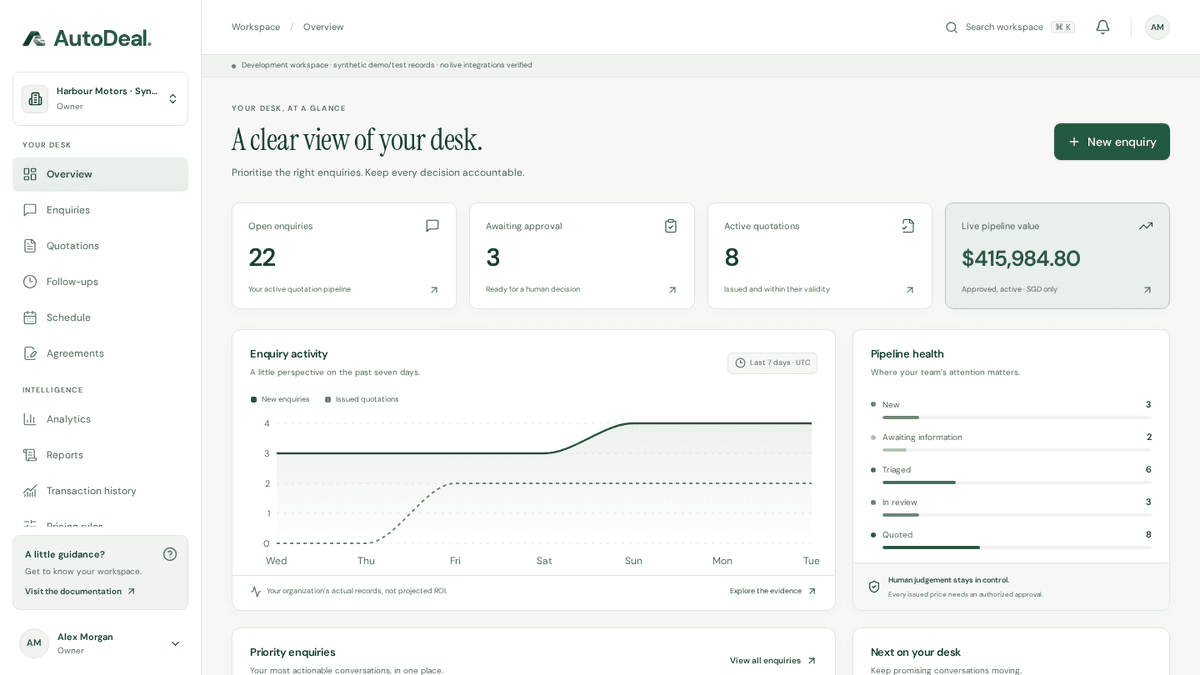
AutoDeal unifies vehicle enquiries, reviewed evidence, pricing decisions and follow-up so procurement and export teams can prepare explainable quotations, control approvals and keep buyer conversations moving.

Über dieses Modell
Description
Product Overview
AutoDeal is an evidence-led vehicle enquiry and quotation workspace for procurement, used-vehicle trading and export teams. It helps a quotation desk turn buyer conversations, vehicle documents and transaction references into an explainable offer, with clear responsibility for review, approval and follow-up.
Instead of passing the same enquiry between messages, spreadsheets and separate notes, the team works from a shared record. Buyer requirements stay beside reviewed vehicle information, historical comparables and the reasoning behind the proposed price. Authorized colleagues approve the commercial decision before issuance, while the offer's validity, response and subsequent versions remain visible.
AutoDeal combines structured workflow, configurable pricing guidance, role-based governance and optional AI assistance. When connected, AI can propose document fields and evidence-led clarification drafts; it does not replace source review, determine a legally certified vehicle condition or issue a quotation autonomously. The team retains control over the facts and the final offer.
For organizations managing individual vehicle assessments and time-sensitive buyer enquiries, AutoDeal supports a more consistent decision process and clearer handoffs. Its practical value is the ability to preserve context, explain commercial judgement and keep the next action visible—without presenting unmeasured savings, conversion improvements or appraisal accuracy as established results.
Release availability: AutoDeal's operational core has been validated locally. Public deployment and production URL validation remain pending, and the identity/billing transports are exercised against approved adapters rather than a live tenant. Connected assistance runs through the approved gateway; where a capability has been verified live (voice-note transcription) the measurement and its limits are stated in the text below, and where it has not (a public deployment), nothing is claimed. The product is not a vehicle safety, title, registry or legal appraisal certification service.
The Problem
A vehicle quotation begins with incomplete commercial context. A buyer may provide a message, a document or an image, but the desk still needs to establish which vehicle is being discussed, what the buyer requires, which figures are supported and what should happen next.
When that work spans conversations, spreadsheets and individual notes, staff must reconstruct the context at each handoff. A historical transaction may be relevant without being directly comparable. A copied value may still need review. A proposed price may be reasonable without its assumptions being visible to the colleague who approves it.
These gaps can create avoidable clarification, repeated preparation and inconsistent explanations. They can also make it harder to distinguish a draft from an approved offer, identify an expiring quotation or determine whether someone has already followed up. The commercial stakes are practical: the team needs to respond credibly while preserving control over pricing and buyer commitments.
AutoDeal addresses this workflow problem. It does not assume that every existing tool is inadequate, or that software alone can resolve physical inspection, statutory eligibility or market-data licensing requirements.
How the Product Solves the Problem
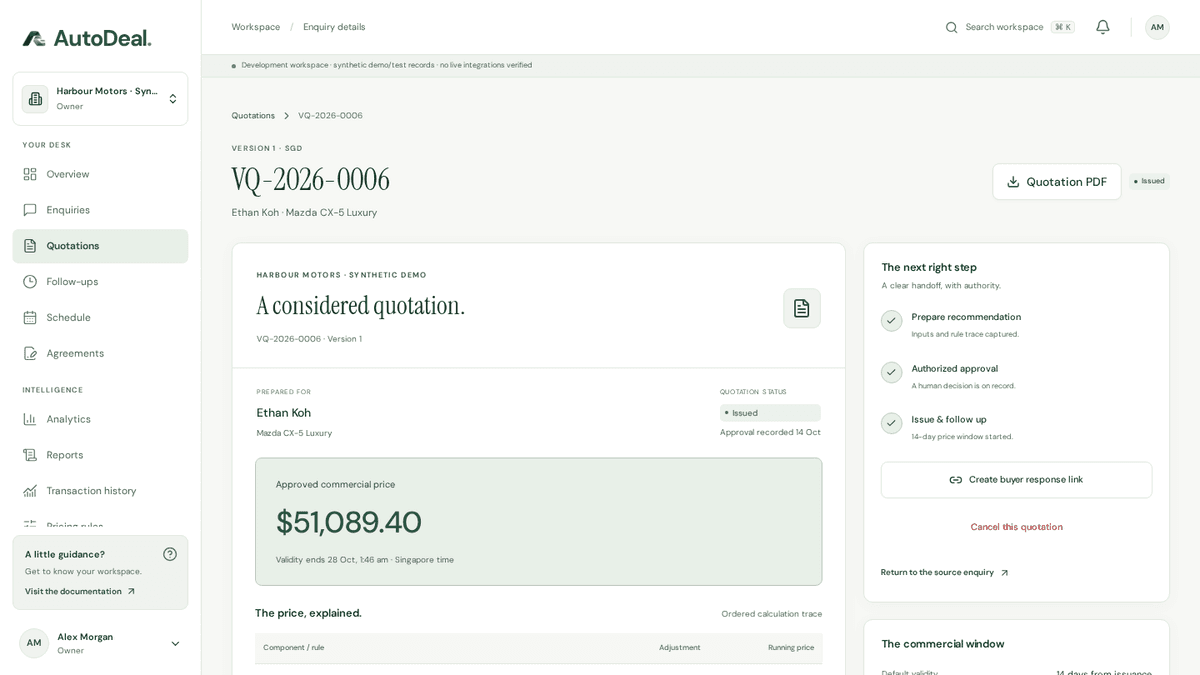
AutoDeal keeps the enquiry and its decision context together. The quotation team captures buyer requirements, records the source of the information and reviews the vehicle evidence before preparing an offer. Historical transactions provide context, while explicit pricing adjustments make the recommendation understandable rather than opaque.
Missing information remains a reason to clarify or review, not an invitation to invent a fact. Optional connected AI can help prepare candidates and clarification drafts, but a person decides whether those suggestions are supported. Approval is a separate commercial step: the authorized reviewer can accept the recommendation or explain an override before the quotation is issued.
After issuance, the workspace connects the approved offer to its validity window, manual follow-up work and buyer-response link. An expired price is not silently treated as a current commitment. A new assessment can produce a new quotation version while retaining the earlier decision context.
The transformation is from repeated reconstruction to a shared, reviewable sequence: understand the enquiry, verify the inputs, explain the price, approve the offer and manage the response.
Source-Market Intelligence
For teams that source from Japan, China and South Korea, the workspace also records source-market evidence against the vehicle and derives the consequences an offer depends on. That includes Japanese frame numbers and the statutory designation code pair, the channels of the electronic inspection certificate that were actually read, condition grades normalised through a nine-tier crosswalk, damage notations in each market's own vocabulary, structural demarcation by component and jurisdiction, statutory odometer analysis, China's GB/T water and fire damage classes, Korea's Article 58-3 guarantee position, the Australian RVSA gate sequence and the origin-specific statutory export checklist.
The boundary is deliberate and stated in the product: licensed registries are not queried or simulated, trim resolution that depends on proprietary catalogues is reported as unresolved, and no monetary coefficient is invented where the research publishes none. Derived values are recomputed from the recorded evidence and shown alongside the arithmetic that produced them, so a reviewer can see why a clean grade became a structural-repair tier or why an export is blocked.
WhatsApp Business Intake
The desk's most common intake channel is now a first-class part of the workspace rather than a copy-and-paste exercise. Each organization connects its own WhatsApp Business number: it stores its own phone-number ID, access token, app secret and verify token, sealed with the deployment key and never shown again by any screen. There is no shared platform number and no hidden operator credential, so a buyer conversation belongs to the organization that owns the number.
Once connected, inbound messages arrive on a signature-verified webhook. Every delivery is checked against the app secret before a byte is trusted, repeated deliveries of the same message are ignored, and delivery receipts only ever move forward. A first message from a new number opens an enquiry automatically — carrying the WhatsApp message reference, the buyer's number and the incoming text — and later messages from the same buyer attach to the same conversation. Attachments arrive as recorded metadata and can be imported into the enquiry's validated document set with one action, which keeps them in the same review path as a manual upload. An attachment is stored once: the message remembers the document it became, so a second press answers with that document instead of downloading the same bytes again, and the conversation keeps showing what the recording turned into — including its transcript — after a reload.
Replying follows the platform's own rules instead of guessing at them. While the 24-hour customer service window is open the desk can send free-form text, a stored PDF/PNG/JPEG document or image as a real attachment, or up to three tappable reply buttons; once the window closes the composer refuses a free-form message with the reason stated and directs the desk to an approved template. Attachments are uploaded to WhatsApp and referenced by media id, so the platform's own storage never has to be publicly reachable, and only a document that belongs to that enquiry can be selected. A received message can be marked as read — a platform status update that tells the buyer the desk has seen the message, not a reply — and templates can be listed, refreshed, submitted for review with their sample values, and deleted, with Meta's own review status shown rather than assumed. Delivery state is tracked per message, and the platform's own rejection text is surfaced rather than replaced with a generic error.
The boundary is stated plainly: this build holds no Meta credentials, so nothing here claims that a message has been delivered to real Meta infrastructure, and template approval remains Meta's decision — the workspace reports the status Meta returns and never marks a submission approved itself. WhatsApp Flows, product/catalogue messages, location, order and payment message types are not implemented.
Voice Notes the Desk Can Actually Read
A buyer who sends a WhatsApp voice note is describing a car in words — often in English or Mandarin — and a note nobody can search or quote is a note that gets forgotten. AutoDeal accepts the recording as a validated document (OGG/Opus, MP3, M4A, WAV or WebM, decided by the file's own bytes rather than its name), keeps it byte-for-byte as received, and offers transcription through the same approved AI gateway the rest of the workspace uses. A recording that arrives in the conversation can be imported and transcribed in one action, and the transcript is then read where the conversation is read: importing stores the file, and queueing the transcription is a separate, deliberate choice, so a deployment that is not paying for AI never spends an AI request on a voice note by accident.
The transcript is a convenience, never an authority. The language the model reports is stored with the text and shown as a hint; a person can type or correct the transcript, and once a transcript has been reviewed by a person a later model run is refused rather than allowed to overwrite it. If the gateway declines to process a recording, the workspace says so, keeps the audio downloadable and asks for a typed transcript instead of pretending it heard something. Live measurement with the product key on 13 October 2026: English audio transcribed correctly in four of four runs; Mandarin audio was delivered on the runs that reached the audio-capable upstream and refused on others (finish_reason: content_filter), which is a property of the shared gateway's routing and is reported as a known limit rather than smoothed over.
Appointments, Agreements and Reports
A price is only half of a deal. The workspace carries the transaction forward: appointments for viewings, inspections, calls, collections and handovers — with a deliberate double-booking refusal that a member can override explicitly and an agenda that merges appointments with agreement milestones, published as a calendar feed the page itself advertises — and agreements with their own currency, totals, signature date and a numbered milestone plan (deposit, documents, inspection, shipment, delivery, registration) that drives what the desk does next.
Reporting answers two different questions. The analytics page is the live view: funnel, turnaround, pricing alignment, buyer response time, follow-up completion, extraction and record quality, and where demand is coming from. A report snapshot is the filed artefact: computed once over the records of that moment, sealed with a SHA-256 digest of its own canonical contents, stored immutably (the database itself refuses to rewrite it), re-verified every time it is read, and exportable as CSV or Markdown together with its source row counts, declared completeness and known limits. Foreign-currency amounts are converted only with a dated reference rate and its named source; when no rate is available the total is reported as not measurable rather than quietly assumed. Agreements carry their own currency and their own totals, and each step can carry an amount. That makes the last money question answerable rather than assumed: cash collected sums the amounts on steps that are done inside the period, and the report states its own coverage — how many of the workspace's steps carry an amount at all. A step with no price stays blank instead of claiming zero, and if one currency has no available rate the collected total is withheld with the reason rather than quietly understated.
Problem-Solving Flow
Value Creation Model
AutoDeal creates value by improving how a quotation decision is prepared, handed over and managed. The economic mechanism is not a claimed universal price improvement: it is less context reconstruction, more explicit commercial reasoning and clearer ownership of the next action.
These capabilities can support specialist capacity, decision consistency and opportunity visibility. Actual impact depends on the organization's enquiry mix, operating policy, evidence quality, adoption and connected services. No numerical financial return is assumed.
Value Creation Table
Key Benefits
The benefits are operational outcomes the product is designed to support. They arise from a shared workflow and visible decision context, not from an unsupported claim that AI can replace expert judgement.
Benefits Table
Before vs. After
AutoDeal changes the organization of the work, not the need for responsible review. The following contrasts describe supported workflow differences rather than guaranteed business results.
Transformation Table
Customer Journey
AutoDeal fits the lifecycle of an individual vehicle enquiry. The organization brings its team into the workspace, captures the buyer's requirements and reviews the available source material. Relevant transaction history and operating policy support preparation, while the authorized reviewer remains responsible for the offer.
Issuance begins the offer's validity window and follow-up sequence. The desk shares a buyer-response link and carries out the follow-up through its own communication channels. A response, a request for clarification or an expiry then informs the next human action. If the commercial assessment changes, a new version can be prepared instead of overwriting the earlier offer.
Operational Flow
Who Benefits
AutoDeal supports a shared quotation operation with different responsibilities. Adoption is strongest when the organization defines its pricing policy, evidence-review practice and approval responsibilities rather than treating the workspace as an autonomous appraiser.
Customer Value Table
Designed-for use cases include assessing a document-led vehicle enquiry, preparing an offer with historical transaction context, handing a recommendation to an authorized reviewer, coordinating an expiring quotation and onboarding colleagues through controlled share links. These are use cases, not claims of named customer adoption.
Business Impact
AutoDeal's potential impact is concentrated in the quotation operation: the use of specialist time, the clarity of commercial decisions and the visibility of buyer follow-through. Results should be evaluated against the organization's own baseline rather than inferred from a demonstration workspace.
Business Impact Table
No measured conversion uplift, guaranteed cost saving, turnaround benchmark or certified appraisal accuracy is asserted. Any improvement should be established through a controlled pilot with representative enquiries and reviewed outcomes.
Strategic Value
A quotation desk often contains valuable knowledge that is difficult to reuse because it is distributed across people and conversations. AutoDeal makes that knowledge more accessible in the context where the team needs it: the enquiry, the reviewed evidence and the decision being prepared.
Standardizing the stages and responsibilities can help an organization modernize the workflow without removing its commercial judgement. Different workspaces can maintain separate access and policy, while shared operating practice becomes less dependent on informal handoffs. This supports a more consistent digital operating model; it is not a claim of completed global registry coverage or unlimited deployment scalability.
The product also preserves a useful boundary between evidence, assistance and authority. Optional connected intelligence can be introduced within a reviewable process rather than by replacing the approval step. That provides a practical foundation for evolving the operation as data rights, integration access and organizational policy mature.
Differentiation
- Vehicle-quotation context rather than a generic task board. Buyer requirements, vehicle evidence, historical transactions, pricing reasoning and offer validity belong to the same commercial workflow.
- Assistance without autonomous issuance. Connected AI can propose inputs and clarification drafts, while people retain responsibility for source review and the final offer.
- A visible decision boundary. Preparation, authorized approval and issuance are distinct; overrides carry a reason rather than becoming an unexplained change.
- History that survives the next version. Earlier offer context is preserved instead of relying solely on a mutable latest record.
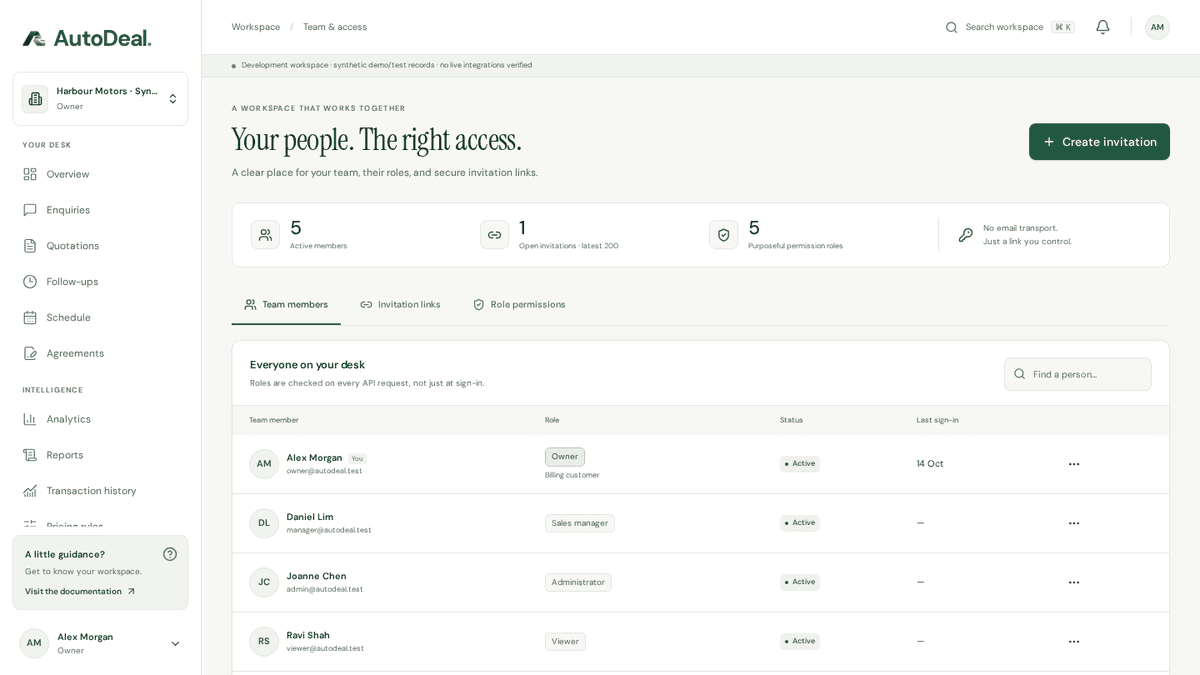
- Controlled team links without email transport. Owners can manage role, expiry, revocation and use limits through shareable invitations; existing membership is not silently escalated.
- Evidence limits made explicit. Unknown or unsupported information is not presented as a verified registry fact, a physical condition certificate or guaranteed statutory cash recovery.
- Source-market rules encoded as testable behaviour. Japanese, Chinese and Korean identification, condition, valuation and export rules are implemented with tests and stated limitations, rather than reduced to a free-text notes field.
These differentiators describe documented product behavior. They are not claims of exclusive market leadership or superiority to every competing system.
Why It Matters
A vehicle quotation is where buyer expectations, evidence and commercial judgement become an offer. When the context is fragmented, the organization must spend effort reconstructing it and explaining the decision after the fact.
AutoDeal brings that context into a shared, reviewable workflow. The strategic priority is not to automate judgement indiscriminately, but to help the team make deliberate decisions and carry them through to the buyer response. Its commercial value lies in the combination of better-organized specialist work, explainable offers and clearer accountability—outcomes to validate in the customer's operation, not numerical promises to assume in advance.
Wichtige Funktionen
Anwendungsfälle
- Assess document-led vehicle enquiries with visible evidence review.
- Prepare a vehicle quotation with historical transaction context.
- Hand a recommendation to an authorized commercial reviewer.
- Coordinate issued-offer validity, manual follow-up and buyer response.
- Onboard quotation colleagues through controlled share links.
- Keep a multi-week export deal on schedule with viewings, milestone dates and a subscribed calendar.
- Support a quoted figure months later with the sealed snapshot it came from.
- Read a buyer's voice note in English or Mandarin and quote from a transcript a colleague approved.
Preispläne
Preispläne
Ähnliche Produkte


NoisePollution Map
Enterprise-grade urban acoustic intelligence platform quantifying sound pressure levels in dB(A), identifying noise pollution sources, and delivering WHO-calibrated mitigation protocols in 3 seconds from audio, photo, or video.


MeetingMinutes Pro
Transform whiteboard photos, meeting discussions, and audio recordings into clear executive meeting minutes, structured summaries, and prioritized action items in seconds.


MachineEar Industrial — Machine Acoustic Failure Diagnostics & Predictive Maintenance
Detect bearing micro-spalling, motor misalignment, and pump cavitation from sound up to 2 weeks prior to catastrophic failure in under 3 seconds.