
LineSense
Operator-side ILI integrity intelligence: multi-vendor tally alignment, Bayesian corrosion growth, ASME B31G / RSTRENG burst screening, API 1163 validation, and engineer-signed dig sheets.
Sobre este modelo
Product Overview
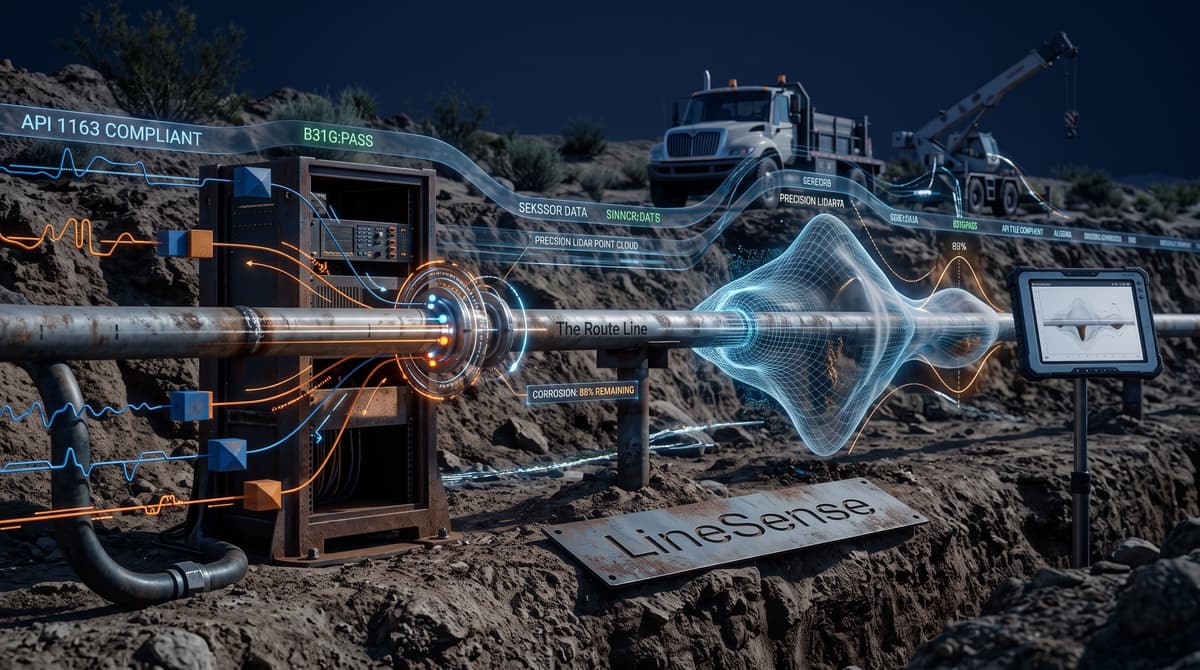
LineSense is an operator-side pipeline integrity intelligence platform purpose-built for midstream oil, gas, and liquid transmission operators. Designed for asset integrity engineering teams managing multi-decade inspection campaigns across heterogeneous inspection vendors — including ROSEN, Baker Hughes, T.D. Williamson, and NDT Global — LineSense transforms disparate in-line inspection (ILI) pipe tallies into prioritized, standards-traceable, and audit-ready excavation decisions without requiring modifications to existing enterprise IT infrastructure.
The platform directly addresses the structural problem of multi-vendor data incompatibility: alternating inspection contractors deliver data in proprietary formats with compounding odometer drift, forcing integrity engineers into months of manual spreadsheet cross-referencing and error-prone linear growth estimations. LineSense ingests operator-owned tabular tallies (CSV, XLSX, XML), normalizes schemas via confirmed column mapping, anchors features to girth welds across consecutive runs, models corrosion growth using Bayesian uncertainty quantification, screens burst pressure under ASME B31G, Modified B31G, and RSTRENG, validates tool performance per API 1163 Level 2 protocols, and drafts engineer-signed dig sheet packets.
Operating strictly as a decision-support platform, LineSense ensures that qualified engineers review and sign every excavation decision. By replacing manual spreadsheet backlogs and uncalibrated linear growth extrapolations with rigorous mathematical modeling, LineSense eliminates the risk of costly exploratory digs and enables pipeline operators to meet their 180-day PHMSA discovery obligations with defensible, code-traceable engineering outputs.
The Problem
Transmission pipeline integrity management operates under compounding technical, operational, and regulatory constraints that traditional engineering toolchains cannot resolve.
Midstream pipeline networks span thousands of miles through High Consequence Areas (HCAs), major water crossings, and sensitive environmental corridors. To maintain asset safety, operators periodically run intelligent pigs. However, the software infrastructure utilized to ingest, align, and act upon inspection deliverables remains dominated by static spreadsheets, isolated desktop viewers, and uncalibrated growth models.
First, competitive bidding cycles and regional tool availability cause operators to alternate inspection service vendors over a pipeline's lifecycle. Each vendor utilizes custom nomenclature, unique feature classification conventions, disparate spatial coordinates, and closed desktop software. Consequently, operators accumulate decades of multi-million-dollar inspection archives stored in incompatible silos that cannot be programmatically aligned or analyzed longitudinally.
Second, intelligent pigs measure distance via mechanical odometer wheels that slip, accumulate debris, and wear over long inspection surveys. This odometer drift introduces spatial discrepancies between 0.1% and 1.0% of total pipeline length — representing up to 400 meters of positional displacement over an 80-kilometer segment. Simple distance lookups across consecutive runs fail, requiring integrity engineers to spend hundreds of hours manually cross-referencing individual pipe joints and girth welds in Excel.
Third, high-resolution Magnetic Flux Leakage (MFL) tools carry depth sizing tolerances of ±10% of nominal wall thickness at an 80% confidence specification. When consecutive runs inspect a static, non-growing corrosion feature, measurement noise frequently causes the repeat tool to report a shallower depth than the baseline run. Naive deterministic subtraction indicates that the pipe wall regenerated, producing an impossible "apparent defect shrinkage" artifact in approximately 40% of slow-growth defects. Engineers are forced to apply arbitrary correction constants or blanket overconservatism that obscures real degradation.
Fourth, exploratory field excavations cost between $30,000 and $150,000+ per dig. Single-point burst screening models and uncalibrated growth rates routinely prioritize stable, non-injurious anomalies for direct examination, draining annual capital budgets while missing rapidly accelerating localized threats.
Finally, under PHMSA 49 CFR § 192.933 and § 195.452, operators have a strict 180-day regulatory discovery clock to declare all condition-directed anomalies and schedule remediation. Compounding vendor delivery delays (60–90 days) with internal manual reconciliation backlogs pushes operating companies to the edge of federal non-compliance.
How the Product Solves the Problem
LineSense replaces the fragile spreadsheet workflow with a standardized, vendor-neutral engineering intelligence pipeline. Operators upload their operator-owned tabular tallies directly into the platform without invasive ERP integrations or on-premise software installation.
The platform immediately inspects the data and provides AI-assisted schema mapping suggestions for unknown vendor formats, requiring explicit human confirmation before persisting records. Every row is accounted for, and formatting errors surface transparently rather than silently dropping critical inspection records.
Once normalized, LineSense executes a deterministic analytical pipeline:
- Landmark Anchoring: Partitions the pipeline into 5–20 km operational blocks using confirmed physical appurtenances (valves, tees, taps).
- Girth-Weld Sequence Alignment: Executes a Needleman-Wunsch dynamic programming algorithm over joint length sequences, compensating for odometer drift and identifying cutouts, reroutes, and pup joints.
- Feature Matching: Conducts point-set registration in joint-normalized spatial frames with double-unrolled circumferential clock angles (avoiding 12:00 wrap-around discontinuities), resolving 1:1, split, and merged anomaly clusters with documented confidence scores.
- Bayesian Corrosion Growth: Evaluates growth per matched pair using an exact conjugate posterior with an explicit non-negative physical growth constraint, deriving tool measurement uncertainty from vendor specifications to output P50 and P95 posterior growth distributions.
- Parallel Burst Screening: Concurrently evaluates ASME B31G, Modified B31G, and RSTRENG effective-area methods (using exact river-bottom profile searches or conservative rectangular equivalents), grouping interacting defects within 25.4 mm axial/circumferential envelopes.
- API 1163 Level 2 Validation: Performs Agresti-Coull binomial validation against field NDE ground truth, outputting formal Accept, Reject, or Inconclusive verdicts with rigorous confidence bounds.
- Governed Decision Records: Generates prioritized dig sheet packets with dual referencing (chainage + distance to nearest girth welds), routing drafts to qualified Professional Engineers for sign-off recorded in an append-only audit ledger.
Problem-Solving Flow
Value Creation Model
LineSense creates substantial financial and operational value by optimizing excavation capital deployment, guaranteeing regulatory compliance, and increasing engineering productivity across midstream integrity programs.
Value Creation Table
Key Benefits
LineSense provides pipeline operators with a vendor-neutral analytical platform that bridges the gap between raw inspection deliverables and defensible field actions.
Benefits Table
Before vs. After
Deploying LineSense fundamentally transforms how integrity departments manage their inspection deliverables and excavation programs.
Transformation Table
Customer Journey
LineSense integrates into the operator's operational lifecycle immediately following tally delivery, establishing a transparent path from raw data to signed excavation.
Operational Flow
Who Benefits
LineSense delivers targeted operational, technical, and strategic value across the integrity organization.
Customer Value Table
Business Impact
LineSense generates immediate, measurable impact across capital efficiency, regulatory posture, and risk governance.
Business Impact Table
Strategic Value
LineSense modernizes the midstream integrity operating model by establishing a durable, operator-controlled digital asset layer.
Rather than remaining dependent on alternating inspection hardware vendors and their closed software ecosystems, pipeline operators establish complete sovereignty over their historical inspection data. The platform creates a standardized, longitudinal integrity ledger where multiple decades of inspection runs are continuously aligned and harmonized.
By embedding codified engineering standards (ASME B31G, Modified B31G, RSTRENG, API 1163) directly into an automated software workflow, LineSense institutionalizes critical technical knowledge, eliminating reliance on bespoke, undocumented internal spreadsheets. Furthermore, the platform's immutable audit ledger preserves the engineering rationale behind every repair or monitoring decision, ensuring seamless institutional memory across engineering team transitions and corporate reorganizations.
Differentiation
- Standards-Codified Deterministic Core: All integrity calculations — sequence alignment, feature matching, Bayesian growth, burst screening, and tool validation — are executed via transparent, deterministic algorithms grounded in codified engineering standards. The platform rejects black-box AI sizing in favor of reproducible, standards-traceable calculations required for regulatory compliance.
- Bayesian Growth with Non-Negativity Constraint: LineSense eliminates the widespread industry artifact of "apparent defect shrinkage" by enforcing a physical non-negativity constraint within an exact conjugate Bayesian posterior, accounting for tool sizing uncertainty and delivering honest P50/P95 growth intervals.
- Vendor-Neutral Data Sovereignty: Ingests and harmonizes tabular tallies from ROSEN, Baker Hughes, T.D. Williamson, NDT Global, and custom formats, breaking vendor lock-in and allowing operators to compare tool performance objectively across campaigns.
- Human-in-the-Loop Governance: LineSense operates strictly as a decision-support system. The platform never autonomously alters MAOP, defers repairs, or submits filings; all excavation recommendations remain drafts until certified Professional Engineers sign off in an append-only audit ledger.
- Operator-Controlled Data Residency: Built to operate within operator-controlled infrastructure without external object-store dependencies, ensuring that safety-critical pipeline asset data remains entirely within corporate security perimeters.
- Integrated Regulatory Clocks: Specifically engineered to address the 180-day PHMSA discovery timeline and API 1163 Level 2 validation requirements, transforming compliance reporting from an afterthought into an automated operational output.
Why It Matters
Midstream pipeline infrastructure represents the critical backbone of global energy transport, operating under intense regulatory oversight, aging asset conditions, and unforgiving safety requirements. For decades, pipeline operators have invested billions of dollars in advanced in-line inspection technologies, only to have the resulting deliverables trapped in incompatible vendor silos and processed through fragile, manual spreadsheets.
LineSense bridges this critical gap by providing operators with the independent analytical intelligence needed to transform raw inspection tallies into defensible, timely, and cost-effective excavation decisions. By eliminating the false-positive excavations that waste millions of dollars in capital and streamlining the engineering workflows required to satisfy federal safety mandates, LineSense empowers integrity teams to safeguard pipeline containment, protect public safety, and maintain complete digital sovereignty over their critical infrastructure.
Principais recursos
Casos de uso
- Aligning consecutive ILI runs from different vendors across multi-decade pipeline inspection archives
- Modeling corrosion growth with Bayesian uncertainty to reduce unnecessary excavation scoping
- Screening burst pressure to ASME B31G, Modified B31G, and RSTRENG for fitness-for-service determinations
- Meeting PHMSA 180-day discovery deadlines with automated tally processing and governed sign-off workflow
- Validating ILI tool performance against field NDE ground truth under API 1163 Level 2 protocols
Planos de Preços
Planos de Preços
Produtos relacionados


Lecture2Exam
Upload whiteboard photos, slides, voice recordings, or lecture notes. Lecture2Exam synthesizes conceptual definitions, 3D interactive flashcards, and scored practice tests with Gemini 2.5 Flash in under 4 seconds.

AutoSub — AI Animated Video Captions
Automated video captioning engine powered by Whisper and ChatGPT. Generates TikTok and Alex Hormozi style animated subtitles with word-by-word timing in 12 viral styles.


LanguageMouth Coach — AI Pronunciation & Biomechanical Mouth Tracking Coach
Upload or capture your mouth shape while pronouncing target sounds. LanguageMouth Coach analyzes lip geometry, jaw opening, and tongue placement with Gemini 2.5 Flash in under 4 seconds.