
Fired Heater Optimizer
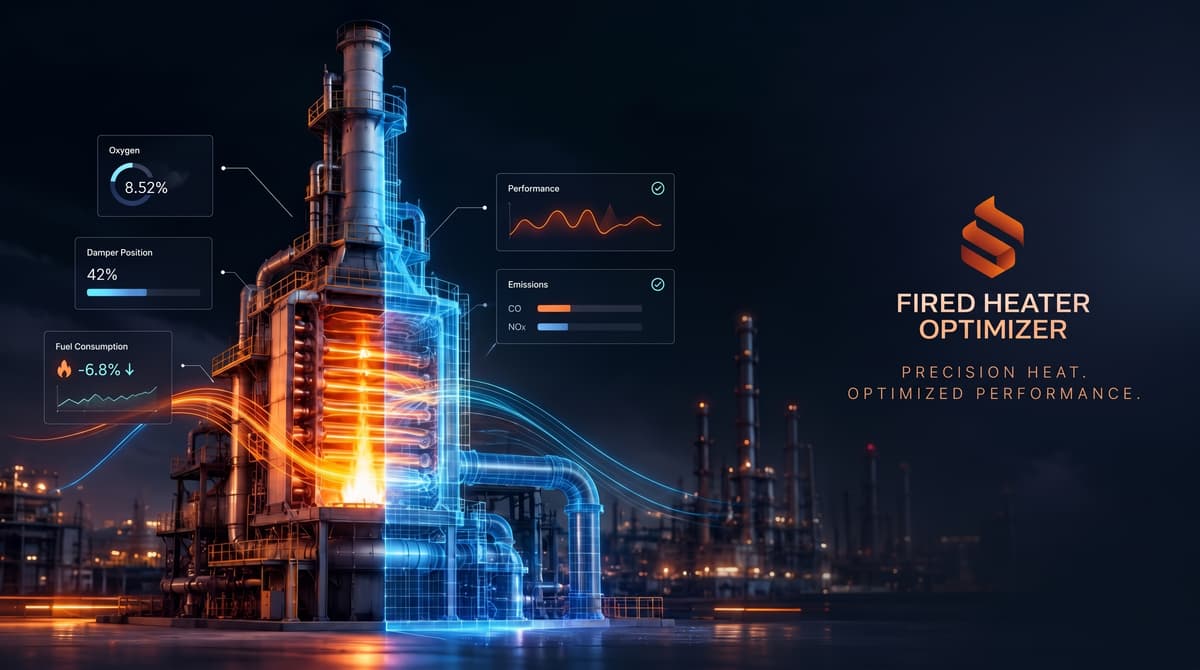
Physics-grounded combustion optimization for refinery fired heaters. Builds a thermodynamic digital twin, certifies every cycle against the plant energy balance, and issues constraint-bounded, explainable setpoint recommendations.
Sobre este modelo
Product Overview
Fired Heater Optimizer is a continuous combustion intelligence platform for refinery and petrochemical operators. It builds a thermodynamic digital twin of each heater from existing plant instrumentation, certifies that twin against the heater's own energy balance every cycle, and issues constraint-bounded, explainable setpoint recommendations to reduce fuel consumption and Scope 1 CO₂ without touching the safety system.
The Problem
Industrial fired heaters account for roughly two-thirds of refinery fuel consumption, yet most plants run them at conservative excess-air margins — typically 3–6% flue-gas oxygen — to stay clear of combustion instability. Every kilogram of excess air beyond what the flame requires is heated and vented up the stack. On a well-run 80 MW heater, this represents 14+ MW of avoidable stack loss, or 16% of the fuel bill, every operating hour.
Operators hold conservative margins because oxygen analyzers drift undetected, tube metal thermocouples detach from welds, and fuel gas heating value can shift 10–30% when upstream units change mode. Existing advanced process control packages drift with these fuel swings, treat tube metal temperature as a static alarm, and produce recommendations that cannot be explained to the console operator who must act on them.
How It Solves the Problem
Four operations execute in sequence on every telemetry cycle:
State certification — five-stage pipeline (range, rate, frozen-tag, spike, cross-instrument) produces a certified state vector with a confidence score. The optimizer runs only when confidence clears the threshold.
Inferential estimation — six quantities the plant does not measure directly are computed: fuel heating value and Wobbe index, convection fouling resistance, coke layer per pass, tramp air infiltration, CO breakthrough edge, and analyzer drift.
Constrained optimization — minimizes fuel plus carbon cost subject to hard limits on arch draft, minimum oxygen, CO, NOx, tube metal temperature, pass imbalance, and fuel pressure. Hard constraints are never priced against savings. The returned point is independently re-verified before the recommendation is issued.
The recommendation — carries proposed setpoint moves with clamped step sizes, expected fuel and carbon savings with uncertainty, the binding constraint and its margin, a numbered causal pathway, and a cryptographic HMAC token for independent verification.
Key Benefits
Before vs. After
Who Benefits
- Operations Directors / Plant Managers — verified savings, defensible compliance numbers, no unit trips
- Site Energy Managers / Process Engineers — auditable efficiency tracking, sensor health, run-length evidence
- Console Operators — clear, bounded, explainable setpoints with full accept/reject authority
- Platform Administrators — entitlement, integration health, metering visibility
Differentiation
- Physics-first: API 560, ASME PTC 4, API 530 — no trained model in the path of any displayed number
- Explainability by construction: causal pathway, binding constraint, uncertainty, and verifiable token on every recommendation
- Advisory-first safety: never reads, writes, or reasons about burner management system interlocks
- Instrument health as a first-class concern: drifting analyzers isolated before they corrupt the optimization
- Continuous fuel quality tracking: heating value inferred every cycle, reconciled on chromatograph refresh
- IPMVP Option B savings verification: two in...
Principais recursos
Casos de uso
- Refinery crude, vacuum, and coker charge heater optimization
- Petrochemical feed preheating and reformer furnace efficiency improvement
- Multi-heater fleet energy management and portfolio emissions compliance
- Decoking run-length extension through continuous pass integrity monitoring
Planos de Preços
Planos de Preços
Produtos relacionados


COI Checker
Checks a vendor's certificate of insurance against the insurance your contract requires, and rules on every limit, date and endorsement one at a time.


GS1 Label Auditor
Checks a photographed GS1 logistic label against its own check-digit arithmetic and catches malformed identifiers before they reach a retailer's dock.


CourtAudio Cleaner — Courtroom Audio Denoising & Acoustic Forensics
CourtAudio Cleaner removes courtroom HVAC hum, acoustic reverberation, and ambient chatter from legal recordings, delivering auditable speaker diarization and lossless WAV outputs in under 4 seconds.