WellGuard AI — Real-Time Wellbore Stability & Stuck Pipe Early Warning
Real-time wellbore stability and stuck-pipe early-warning platform for drilling teams. Evaluates 1 Hz surface telemetry against physics baselines to detect pre-sticking signatures 10–30 minutes before lockup with SOP mitigation runbooks.
Sobre este modelo
WellGuard AI — Marketplace Description
Product Overview
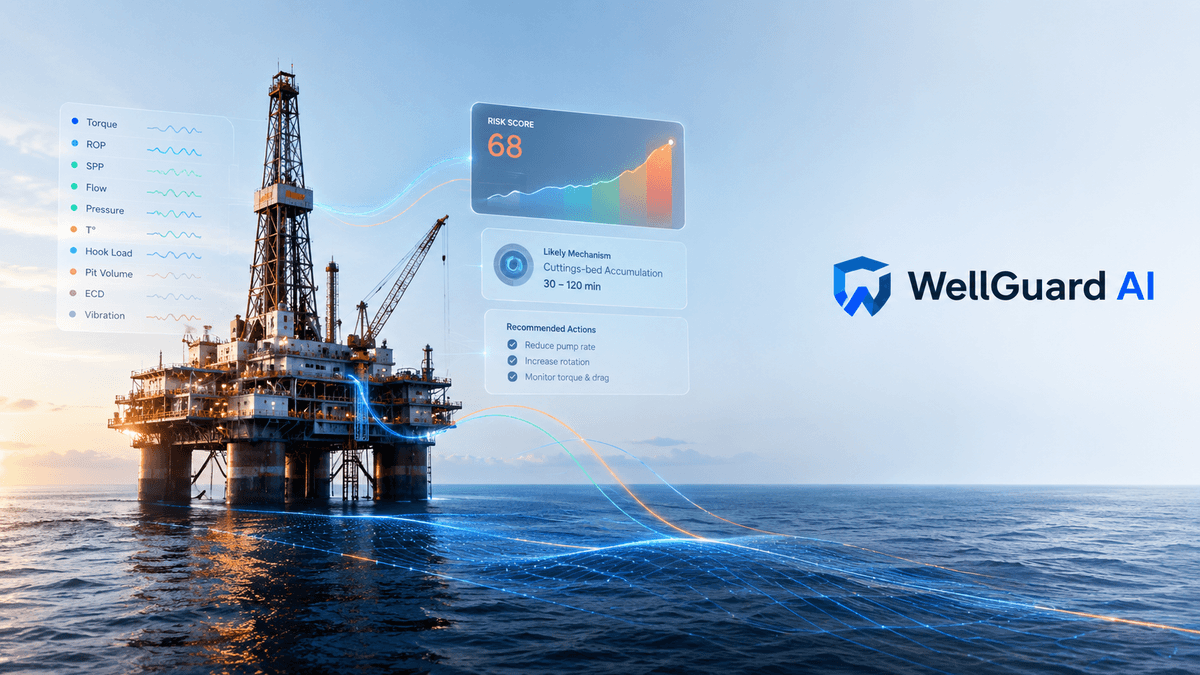
WellGuard AI is a real-time wellbore stability and stuck-pipe early-warning platform built for drilling teams — from rig-floor drillers to Remote Real-Time Operations Centers (RTOCs) monitoring multiple wells simultaneously. It belongs to the emerging category of advisory decision-support software for upstream oil and gas operations.
Drilling operations generate a continuous stream of surface sensor data. Yet despite this wealth of information, teams consistently miss the early, subtle signs that a drillstring is approaching a stuck-pipe incident — until it is already locked up. WellGuard AI turns that stream of raw telemetry into a clear, explainable risk picture, delivered 10 to 30 minutes before mechanical lockup. It tells the crew not just that something is wrong, but what is wrong, why the score is rising, and what to do about it — before an expensive event becomes an unrecoverable one.
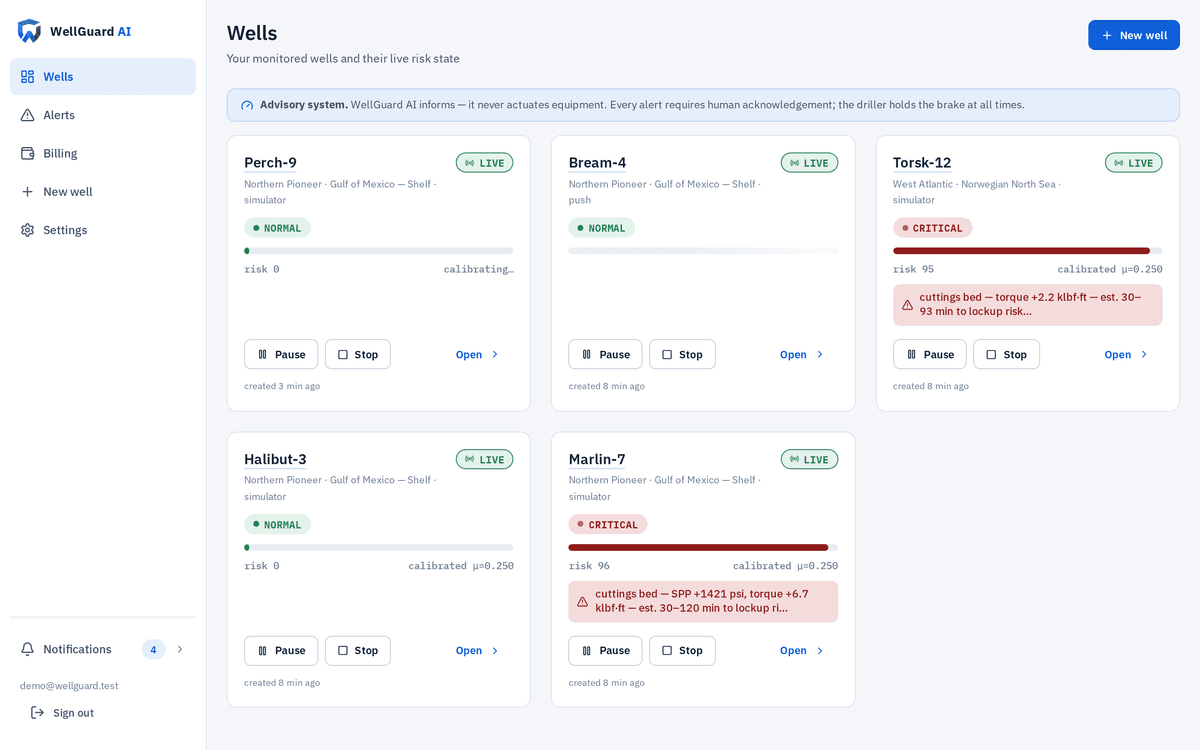
Delivered as a Sensifai Marketplace application with single sign-on and prepaid pay-as-you-go billing, WellGuard AI requires no new hardware, no downhole tools, and no vendor data agreements to evaluate. A team can connect a well from the built-in simulator, watch it calibrate, and observe the full alert lifecycle in under five minutes.
The Problem
Stuck pipe is one of the most financially damaging events in well construction. Industry data cited in WellGuard AI's foundational research places direct incident costs between $150,000 and $16,000,000 per event, depending on operating environment — with deepwater drillship spread rates alone exceeding $450,000 to $650,000 per day. Stuck pipe consistently accounts for 20% to 25% of total drilling downtime across global operations.
The fundamental operational gap is not a lack of data. Modern rigs stream dozens of sensor channels in real time. The gap is that conventional alarm systems only confirm stuck pipe after the string has already locked up. By the time a static threshold alarm fires, the window for preventive action has closed.
At the same time, the slow, multi-channel drift that precedes a stuck-pipe event is genuinely difficult for a human observer to track. A pressure increase that is normal during a pump adjustment looks almost identical to the early signature of an annular pack-off. A gradual torque rise during a long lateral section might be routine cuttings transport — or the beginning of a cuttings-bed buildup that will pin the string during the next connection. Without automated, rig-state-aware analysis, these distinctions are invisible until it is too late.
False alarms compound the problem in the other direction. A system that cries wolf too often costs 2 to 4 hours of rig time per incident and erodes crew trust to the point where real warnings are ignored.
The industry needs a warning window — not a post-event confirmation.
How the Product Solves the Problem
WellGuard AI transforms raw telemetry into an actionable risk picture through a business workflow designed around the drilling team's decision cycle:
The system self-calibrates to each well during trouble-free drilling — typically within the first 10 minutes — so that alerts are keyed to that specific well's normal behavior, not a generic industry baseline. This per-well calibration is what allows the system to distinguish a routine pump change from a genuine precursor, reducing the false alarm rate without sacrificing lead time.
Value Creation Model
Key Benefits
Before vs. After
Customer Journey
Who Benefits
Business Impact
Strategic Value
WellGuard AI addresses a gap that operational technology vendors have not historically filled: the space between raw telemetry and human decision. Major service company platforms provide data aggregation and visualization. WellGuard AI adds a layer of continuous, automated, rig-state-aware risk intelligence on top of that data — without requiring any change to existing infrastructure.
For organizations building or maturing their digital drilling capability, WellGuard AI offers a deployable, commercially predictable starting point. Because it operates on standard surface channels with no hardware dependency, it can be adopted incrementally: beginning with simulator-based evaluation, progressing to live well monitoring, and eventually scaling across a multi-rig fleet through the RTOC dashboard. The usage-based pricing model means the cost of adoption tracks directly with the level of operational engagement, with no upfront capital commitment.
Differentiation
- Rig-state-aware analysis: Risk scoring adjusts automatically across drilling, sliding, reaming, tripping, and connections — the operational contexts where false alarms are most common and most damaging.
- Per-well calibration: The system learns each well's normal behavior before arming alerts, rather than applying generic industry thresholds.
- Mechanism-specific guidance: Alerts identify which of five researched sticking modes is most likely and deliver the corresponding SOP runbook — not a generic "check your parameters" message.
- Transparent scoring: Every alert shows the specific channels driving the risk score and by how much, so engineers can audit the reasoning, not just accept a black-box output.
- No hardware barrier: The platform connects to existing surface telemetry streams with no downhole tools, no wired drill pipe, and no rig modifications.
- Honest boundaries: The product is explicit about what it does and does not do — advisory decision-support only, with no machine actuation, stated in-product and documented openly.
Why It Matters
Stuck pipe is not a new problem, and the industry has accumulated decades of hard-won knowledge about its causes, signatures, and responses. What WellGuard AI provides is not a replacement for that expertise — it is a force multiplier for it. It automates the pattern-recognition work that is genuinely difficult for a human observer to do reliably across multiple channels, multiple operational states, and multiple simultaneous wells.
For drilling teams, the value is simple: a 15-minute warning that lets a driller pull off bottom and circulate before mechanical lockup is worth far more than the most detailed post-event analysis of how the event occurred. WellGuard AI exists to make that warning window visible, explainable, and actionable — consistently, at scale, without requiring new hardware or new infrastructure.
Principais recursos
Casos de uso
- Onshore Unconventional Lateral Drilling Surveillance
- Deepwater & Floating Rig High-Risk Section Monitoring
- Extended-Reach Drilling (ERD) & Cuttings Transport Management
- Real-Time Operations Center (RTOC) Multi-Rig Remote Fleet Surveillance
- Pre-Spud Simulator Training & Stuck-Pipe Scenario Replay
Planos de Preços
Planos de Preços
Produtos relacionados

AdjusterReport AI
Turn damage photos and adjuster voice notes into carrier-standard reports, line-item scopes, and photo sheets in under 60 seconds.

WaterMeter Snap
Autonomous optical meter OCR, rolling dial reader, real-time consumption telemetry, and predictive leak detection for residential and commercial water meters.


WarrantyKeeper
Autonomous receipt OCR, warranty expiration tracking, coverage disentanglement, and claim dossier generation for appliances and electronics.