
PartMatch
Engineering-validated MRO spare parts intelligence, deduplication, and inventory pooling platform for asset-intensive enterprises.
Over dit model
Product Overview
PartMatch is an enterprise industrial MRO spare-parts intelligence and catalog rationalization platform delivered natively on the Sensifai Marketplace. Designed for asset-intensive enterprises across energy, mining, chemical processing, heavy manufacturing, and utilities, PartMatch solves the systemic problem of catalog duplication, hidden part interchangeability, and fragmented purchasing across multi-site operations. In industrial plants, decades of maintenance workarounds, corporate acquisitions, and disconnected ERP migrations cause identical physical spares to accumulate under disparate internal part numbers, leading to costly duplicate purchases, bloated working capital, and avoidable operational downtime.
PartMatch transforms unstandardized ERP exports, purchase order histories, and technical datasheets into an engineering-governed, asset-aware master inventory. Unlike conventional data-cleansing tools or statistical similarity models, PartMatch operates on a fundamental principle of operational safety: AI proposes, physics decides, and authorized humans approve. While advanced natural language models normalize text and extract technical specifications, a deterministic engineering constraint engine independently evaluates physical, metallurgical, dimensional, and electrical boundaries. Every proposed substitution is substantiated by verifiable evidence and routed to qualified reliability engineers before execution. By reconciling duplicate parts, intercepting redundant purchase orders, and uncovering cross-site inventory pooling opportunities, PartMatch releases trapped working capital while safeguarding operational reliability.
The Problem
Asset-intensive operations depend on hundreds of thousands of maintenance, repair, and operations (MRO) spare parts to ensure continuous production. While MRO procurement typically represents 0.5% to 4.5% of total operating revenue, the unavailability of a single critical spare can shut down an entire processing line or offshore platform, endangering the remaining 95.5% to 99.5% of facility revenue. In response to this risk, plants develop deeply fragmented, defensive inventory behaviors that degrade master data over time.
Decades of decentralized storerooms, ad-hoc maintenance modifications, supplier rebrandings, and incomplete ERP migrations leave enterprise material masters severely compromised. Frontline maintenance technicians under severe time pressure often struggle to locate existing inventory due to cryptic abbreviations or inconsistent manufacturer records. As a consequence, they routinely generate new material masters for items already sitting in internal stock. Industry data demonstrates that between 5% and 7% of all MRO purchase orders are direct duplicates of materials already held in inventory. Furthermore, large enterprise organizations face an estimated annual cost of approximately 750 million in annual MRO spend experience avoidable cash outflows between 52.5 million annually.
Traditional catalog cleansing engagements fail to solve this challenge because they treat the symptom rather than the operational root cause. Typically costing between $5,000 and $15,000 per 10,000 records and requiring 3 to 12 months to execute, third-party consulting cleanups deliver static spreadsheets that decay within months of handover. Because traditional approaches rely on superficial description matching without engineering validation, they cannot determine whether two parts are physically interchangeable under plant operating conditions. As soon as technicians encounter unverified data, manual entry resumes and catalog proliferation repeats.
How the Product Solves the Problem
PartMatch replaces one-off data cleansing with continuous, engineering-governed catalog intelligence. Customers load their standard tabular exports—from SAP ECC, SAP S/4HANA, IBM Maximo, Infor EAM, or generic spreadsheets—without requiring complex on-premise software installation or invasive ERP write-back permissions. PartMatch automatically inspects, validates, and meters every record, immediately highlighting invalid rows or mapping gaps with complete transparency.
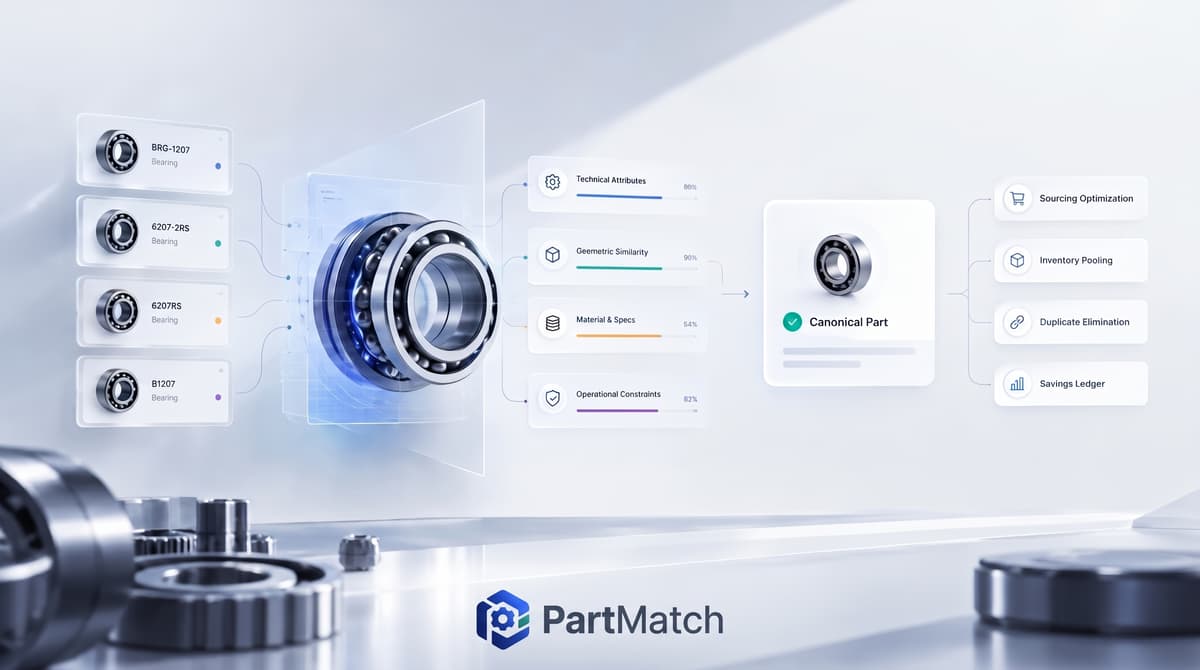
Once ingested, PartMatch executes an automated intelligence pipeline that normalizes technical units, resolves manufacturer aliases, classifies items against standardized taxonomic hierarchies (eCl@ss and UNSPSC), and extracts structured engineering attributes with page-level document provenance. Instead of relying on generative AI to declare mechanical interchangeability, PartMatch routes candidate part pairs to a deterministic constraint engine. This engine evaluates 82 physical, electrical, and metallurgical rules across 10 core industrial part classes, testing critical parameters such as bore tolerances, pressure ratings, temperature envelopes, and hazardous area certifications in both directions.
When physical constraints pass, PartMatch computes a decoupled four-vector confidence assessment—evaluating textual similarity, attribute completeness, manufacturer authority, and technical feasibility independently. High-confidence candidates are presented to designated reliability engineers, storeroom managers, and procurement leads in an auditable review queue. Authorized approvals establish canonical part records that link directly to commercial sourcing workflows: alerting buyers to purchase price variances across facilities, intercepting duplicate requisitions before purchase orders are issued, and surfacing surplus inventory at sister plants to eliminate emergency spot buys.
Problem-Solving Flow
Value Creation Model
PartMatch delivers direct economic return by addressing the structural drivers of MRO inventory inflation and procurement leakage. Economic value is created through four primary mechanisms: eliminating redundant procurement, capturing cross-site purchase price variance, releasing surplus working capital, and avoiding emergency expedite fees. Because all financial calculations derive directly from the customer's verified historical purchase rows, every projected saving is fully auditable and defensible.
Value Creation Table
Key Benefits
PartMatch provides industrial operators with an asset-aware intelligence layer that converts unstructured material records into operational and financial clarity.
Benefits Table
Before vs. After
Deploying PartMatch fundamentally alters how engineering and procurement teams discover, purchase, and manage spare parts.
Transformation Table
Customer Journey
PartMatch integrates smoothly into daily plant operations, transforming raw data exports into verified procurement actions through a governed, step-by-step lifecycle.
Operational Flow
Who Benefits
PartMatch bridges operational, technical, and commercial stakeholders across industrial enterprises, aligning cross-functional teams around a single source of catalog truth.
Customer Value Table
Business Impact
By systematically eliminating catalog bloat and unlocking cross-site inventory visibility, PartMatch creates quantifiable operational and financial improvements.
Business Impact Table
Strategic Value
PartMatch delivers strategic enterprise capabilities that modernize legacy industrial maintenance and establish an extensible operational foundation:
- Institutional Knowledge Retention: Preserves critical engineering interchangeability records and substitution histories within an immutable enterprise repository, insulating operations against workforce turnover and retirement.
- Legacy System Harmonization: Unifies diverse ERP, EAM, and CMMS platforms across acquired facilities and legacy plants without requiring expensive, multi-year software consolidation programs.
- Enterprise-Wide Multi-Site Pooling: Transforms isolated local storerooms into a coordinated, virtual enterprise parts network, reducing aggregate capital exposure while strengthening regional resilience.
- Defensible Digital Governance: Establishes clear, auditable lines of demarcation between AI data extraction, physics-based constraint validation, and human engineering authorization.
- Future-Ready Supply Chain Operations: Creates clean, attribute-rich master data that serves as the foundation for automated robotic warehousing, predictive inventory reordering, and integrated marketplace procurement.
Differentiation
PartMatch is fundamentally differentiated from generic catalog cleaners, general-purpose master data management platforms, and pure generative AI tools:
- Physics-Grounded Constraint Engine: Rather than relying on fuzzy linguistic matching, PartMatch tests candidates against 82 deterministic engineering rules across 10 equipment classes, enforcing hard boundaries on critical parameters such as bore, pressure, and voltage.
- Decoupled Four-Vector Confidence: Never collapses candidate assessment into a single ambiguous percentage. PartMatch evaluates Textual Similarity, Attribute Completeness, Manufacturer Authority, and Technical Feasibility independently so engineers see exactly where data is strong or deficient.
- Strict Human-in-the-Loop Governance: Built on the non-negotiable principle that AI proposes, physics decides, and humans approve. Role-based permissions guarantee that only qualified reliability engineers can authorize cross-manufacturer equivalences.
- Transparent Refusal & Provenance Architecture: Rejects flawed records with explicit, auditable failure reasons instead of silently guessing missing fields. Every extracted attribute maintains verifiable page-level provenance back to source datasheets.
- Direct Purchase Order Sourcing Ledger: Directly ties deduplication results to historical purchase records and active requisitions, computing verified savings based on actual customer transactions rather than theoretical projections.
Why It Matters
In capital-intensive industries, operational uptime and capital efficiency are often viewed as competing objectives. Maintaining excessive safety stock ties up millions in cash, while lean inventory exposes facilities to catastrophic production downtime when a single uncataloged component fails.
PartMatch dissolves this false dichotomy. By pairing artificial intelligence for data normalization with deterministic physical constraints for engineering validation, PartMatch gives enterprises absolute certainty regarding what spare parts they own, where those parts are located, and whether alternatives can safely operate in service. The result is a resilient, transparent, and capital-efficient MRO supply chain where engineering integrity safeguards plant operations and commercial clarity unlocks millions in measurable value.
Belangrijkste functies
Use-cases
- Multi-site MRO spare parts catalog deduplication and rationalization
- Inter-facility inventory pooling to eliminate emergency spot purchases
- Automated purchase requisition interception to avoid duplicate buying
- Cross-site Purchase Price Variance (PPV) optimization and spend consolidation
- Engineering substitution verification and Management of Change compliance
Prijsplannen
Prijsplannen
Gerelateerde producten


Lecture2Exam
Upload whiteboard photos, slides, voice recordings, or lecture notes. Lecture2Exam synthesizes conceptual definitions, 3D interactive flashcards, and scored practice tests with Gemini 2.5 Flash in under 4 seconds.


AutoSub — AI Animated Video Captions
Automated video captioning engine powered by Whisper and ChatGPT. Generates TikTok and Alex Hormozi style animated subtitles with word-by-word timing in 12 viral styles.


LanguageMouth Coach — AI Pronunciation & Biomechanical Mouth Tracking Coach
Upload or capture your mouth shape while pronouncing target sounds. LanguageMouth Coach analyzes lip geometry, jaw opening, and tongue placement with Gemini 2.5 Flash in under 4 seconds.