PermitGuard AI
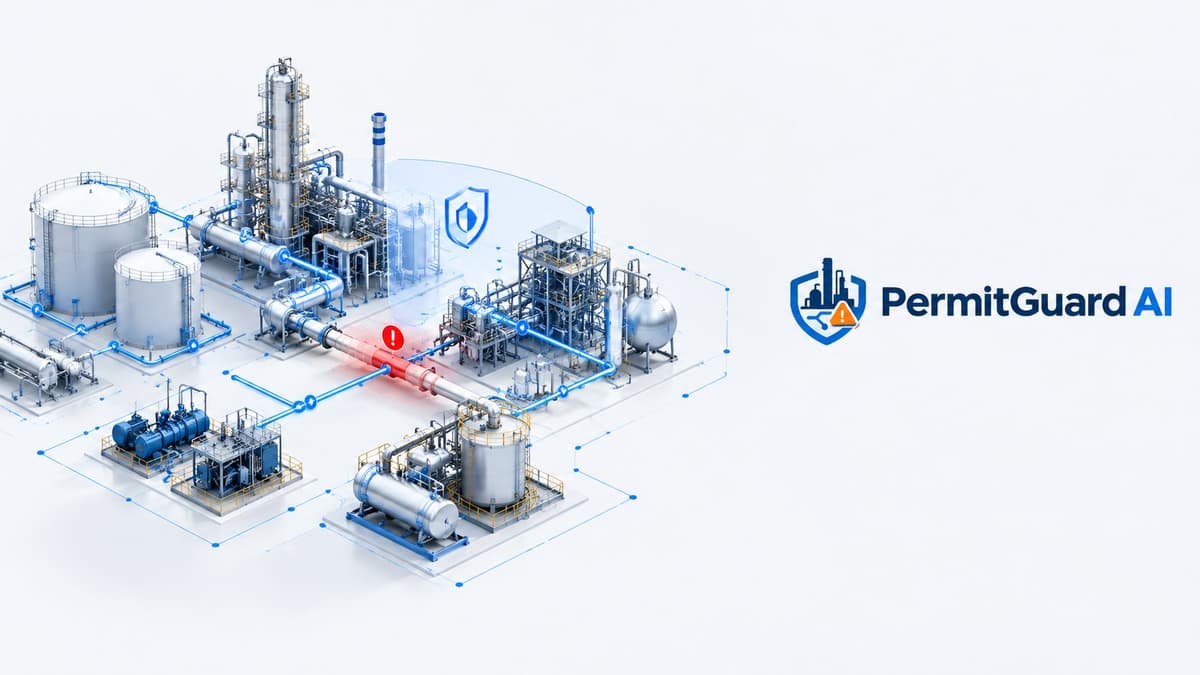
Safety intelligence platform evaluating simultaneous industrial permits against live piping topology, 3D spatial layout, and energy isolation barriers to prevent catastrophic incidents.
About This Model
Description
Product Overview
PermitGuard AI is an enterprise safety intelligence platform designed for Permit-to-Work (PTW) and Lockout/Tagout (LOTO) programs that govern high-risk maintenance and simultaneous operations (SIMOPS) across oil refineries, petrochemical complexes, offshore platforms, and heavy process manufacturing sites. It serves plant operations directors, corporate health, safety, and environment (HSE) executives, safety permitting officers, and field area authorities who manage dozens to hundreds of concurrent hazardous work activities.
Traditional electronic permitting systems track permits as isolated administrative paperwork or coarse zone checklists, failing to evaluate whether concurrent tasks share live physical piping, overlapping spark radii, electrical feeds, or common isolation boundaries. This structural blind spot creates severe process safety vulnerabilities that can escalate into loss of primary containment, fires, toxic vapor cloud releases, or catastrophic incidents.
PermitGuard AI continuously evaluates every requested and active permit against the facility's actual physical layout, 3D spatial geometry, and process connectivity. By analyzing piping and instrumentation diagrams (P&IDs), isolation boundaries, and simultaneous operations rules, the platform surfaces hidden spatial, temporal, and topological conflicts before permits are authorized. By combining deterministic safety verification with clear, plain-language hazard explanations, PermitGuard AI accelerates permit review velocity, eliminates dangerous oversights, and preserves complete human authority over every safety decision.
The Problem
High-hazard industrial facilities operate under rigorous process safety regulations (OSHA 1910.119 PSM, OSHA 1910.147 LOTO, API RP 75, and IOGP 415) because operational margins for error are exceptionally narrow. Even a minor coordination oversight—a hot-work welding torch operating near an open hydrocarbon line break, a lockout padlock prematurely removed from an energy isolation valve, or conflicting tasks inside adjacent confined spaces—can trigger catastrophic asset loss, regulatory shutdowns, or fatalities.
Despite the widespread shift from paper clipboards to first-generation electronic permit-to-work (ePTW) software, control rooms remain exposed to hazardous blind spots. Legacy systems manage permit approvals through static administrative zone dropdowns and magnetic board reviews. Permitting authorities spend 18 to 25 minutes per permit manually cross-referencing plot plans, P&ID binders, and disjointed permit lists during high-pressure morning permit-issue windows.
This manual process creates three severe, recurring operational failures:
- Topological Invisibility: Permits appear independent in documentation but are physically connected through common piping manifolds, shared bypasses, or common electrical switchgear.
- Coarse Spatial Assumptions: Legacy zone-based SIMOPS tools generate 35% to 50% false-positive rates by flagging unrelated jobs within arbitrary administrative boundaries, causing alarm fatigue and routine unauthorized overrides, while simultaneously missing true 3D spatial spark-fall and vapor-dispersion hazards that cross zone lines.
- Isolation Boundary Drift: When multiple contractor crews share common isolation points, shift handovers and permit status changes can leave valves or breakers in unverified states, compromising zero-energy isolation.
The business impact is severe: turnaround schedules incur costly contractor standby delays, administrative teams spend weeks manually assembling defensible audit logs following safety reviews, and facilities face massive operational, reputational, and legal exposure.
How the Product Solves the Problem
PermitGuard AI bridges the gap between administrative permit records and physical plant reality. Rather than replacing existing maintenance or enterprise asset management systems, PermitGuard AI functions as an intelligent safety evaluation layer that continuously verifies concurrent operational activities against the plant’s real engineering connectivity.
When a work permit is submitted or updated, PermitGuard AI automatically ingests the task parameters—including job classification, planned schedule, spatial coordinates, and tagged equipment assets. The platform immediately maps the permit onto the facility’s digital topology, executing deterministic safety rules across three core dimensions:
- Spatial Proximity: Evaluates true 3D Euclidean distances against recognized standards (such as NFPA 51B 35-foot hot-work clearance envelopes) and elevated spark-fall trajectories.
- Topological Isolation: Performs graph traversals across piping and instrumentation networks to verify positive physical isolation (double block and bleed or blinded lines) between hazardous energy sources and work locations.
- SIMOPS Compatibility: Cross-references simultaneous tasks against an codified operational matrix (IOGP 415 standards) to flag incompatible concurrent activities, such as hot work conducted near solvent line drainage.
When potential hazards are detected, PermitGuard AI delivers clear, evidence-based explanations describing the exact physical connection and risk mechanism. Final decision authority always remains with licensed human safety authorities: reviewers can accept recommendations, enforce additional safeguards, or execute a governed, co-authorized override workflow. Every evaluation, sign-off, and override is recorded in an immutable, tamper-evident audit ledger.
Problem-Solving Flow
Value Creation Model
PermitGuard AI delivers measurable economic and operational value by safeguarding workforce safety, accelerating maintenance cycles, and codifying institutional safety practices.
Value Creation Table
Key Benefits
PermitGuard AI provides operations leaders and safety authorities with predictive, actionable intelligence that transforms reactive safety compliance into proactive operational assurance.
Benefits Table
Before vs. After
Transformation Table
Customer Journey
PermitGuard AI integrates seamlessly into the daily industrial permitting lifecycle, supporting operations from initial permit request through final closeout and audit retention.
Operational Flow
Who Benefits
PermitGuard AI delivers tailored operational value across every level of the facility hierarchy.
Customer Value Table
Business Impact
Implementing PermitGuard AI delivers tangible operational, financial, and strategic improvements across industrial manufacturing assets.
Business Impact Table
Strategic Value
Industrial operators face intense commercial pressure to improve operational efficiency while maintaining zero-incident safety records. Experienced permitting officers and senior operations personnel are retiring, taking decades of intuitive plant knowledge with them.
PermitGuard AI captures, codifies, and institutionalizes this critical process safety intelligence. By embedding engineering standards and facility topology into an automated evaluation engine, facilities ensure that rigorous safety governance is consistently enforced across every shift, contractor crew, and turnaround campaign. The platform provides a future-ready digital safety backbone that scales effortlessly from individual processing units to global enterprise asset fleets.
Differentiation
- Topological Process Connectivity: Unlike conventional tools that evaluate permits based solely on metadata tags or administrative areas, PermitGuard AI traces the plant's actual physical piping, valves, and electrical infrastructure to detect unisolated energy and fluid pathways.
- Deterministic Safety Core with Bounded AI: Safety decisions are calculated strictly by formal, mathematically verifiable deterministic algorithms (BFS/DFS graph traversal and PostGIS 3D spatial modeling), while non-authoritative AI is bounded strictly to plain-language explanation and entity extraction—guaranteeing 100% fail-closed safety.
- High-Fidelity 3D Spatial Geometry: Incorporates actual equipment elevation, 3D spark-fall trajectories, and NFPA 51B hot-work combustible envelopes rather than arbitrary two-dimensional zone boundaries.
- Governed Dual-Authorization Override Workflow: Recognizes real-world operational complexities by providing a strictly governed, audit-logged override mechanism requiring documented mitigations, photo evidence, and co-authorization.
- Universal Topology Ingestion: Natively parses industry-standard DEXPI XML and native engineering schemas, converting static CAD and P&ID drawings into an operational, queryable safety graph.
- Continuous, Tamper-Evident Auditability: Every permit state change, conflict check, user sign-off, and override is automatically recorded in an immutable ledger, ensuring immediate audit defense.
Why It Matters
In high-hazard process industries, safety permitting is not merely an administrative exercise—it is the operational barrier that protects human lives, multi-billion-dollar infrastructure, and surrounding communities from catastrophic disasters. Yet for decades, permitting teams have been forced to rely on disconnected documents, static checklists, and manual memory to coordinate simultaneous high-risk activities.
PermitGuard AI bridges the gap between engineering reality and daily operations. By evaluating every permit against the physical plant and live operations, it transforms permitting from a reactive administrative bottleneck into an active, proactive safety barrier. Operations teams achieve faster permit turnaround and uninterrupted maintenance velocity, while corporate leadership gains verifiable assurance that their workforce and assets remain completely protected.
Key Features
Use Cases
- Turnaround and shutdown multi-crew simultaneous operations coordination
- Refinery and petrochemical hot work near hydrocarbon line break clearance
- Hazardous energy isolation and LOTO boundary conflict verification
- Confined space entry atmospheric and chemical line-clearing validation
- Continuous shift handover and contractor work permit risk assessment
Pricing Plans
Pricing Plans
Related Products


CallQA 100
Automated QA scorecards, script compliance, empathy metrics & churn risk analysis for 100% of contact center calls in seconds.


BoatSurvey Snap
Pre-Purchase Boat Photo & Audio Survey for Buyers, Insurers & Marinas — instant hull blister, corrosion, and engine bay inspection.


BlueprintTakeoff AI
Construction Quantity Takeoff from Plan PDFs and Photos in Minutes — instant materials, wall/slab takeoffs, and cost estimates.